
The Meta AI Instagram hack is one of those stories that sounds made up. Attackers took over trusted accounts, from a former White House page to a makeup brand, and used them to post things their owners never wrote.
What Happened With Those Hacked Instagram Accounts?
Late last month, the old Instagram account from Barack Obama’s White House started posting again, with messages taking shots at President Trump. The account had been quiet since 2017, and as The New York Times reported, his old office had nothing to do with the new posts.
Back in March 2026, Meta rolled out an AI tool called High Touch Support to help people get back into locked Instagram accounts. Within a few weeks, attackers worked out how to turn it against account holders, taking over profiles that were not theirs. The abuse first came to light when 404 Media showed how the trick worked.
More details came out over the following days. The New York Times put the figure at around 34,000 accounts affected. Meta later told Maine’s attorney general that 20,225 of them were compromised, over about seven weeks from April 17 until it pulled the tool. The same internal documents the Times saw showed more than 3,500 accounts had their usernames changed.
How Did Hackers Get in Without a Password?
There was no malware here and no stolen password. The attackers talked to Meta’s own support bot and got it to hand over accounts that belonged to other people.
Here is the part that mattered. When someone asks to reset a password, the system is meant to check that the email making the request matches the email already on the account. That check failed. Meta’s breach notice explains that a bug in another part of the code meant the bot never confirmed the two emails belonged to the same person, so an attacker could type in your username, give their own email, and get your reset link sent straight to them.
In that same filing, Meta said the system “did not properly verify” that the email belonged to the account holder.
Here is what the attack looked like step by step, based on the videos TechCrunch reviewed, the walkthrough 404 Media published, and the breakdown from CPO Magazine:
| Step | What the attacker did | What the bot did |
|---|---|---|
| 1 | Picked a target account and used a VPN to look like they were in the victim’s area | Saw nothing odd about the location |
| 2 | Asked the AI assistant to add their own email to the target’s account | Sent a verification code to the attacker’s email |
| 3 | Read the code back into the chat | Treated the email as confirmed |
| 4 | Asked for a password reset | Sent the reset link to the attacker’s email |
| 5 | Set a new password | Handed over the account, unless two-factor was on |
Important note: Two-factor authentication is what made the difference here. Accounts that had it switched on stayed safe, and the ones that didn’t are the names that ended up in the news.
Whose Accounts Got Taken Over?
As TechCrunch and 404 Media tracked it, the accounts that drew attention belonged to public figures, brands, and even a security researcher. The posts that went up were built to embarrass whoever owned the account.
| Account | Who they are | What happened |
|---|---|---|
| Obama White House page | A former White House account, dormant since 2017 | Taken over and used to post messages attacking President Trump |
| John Bentivegna | Chief Master Sergeant of the U.S. Space Force | Account posted pro-Iran messages |
| Sephora | The makeup brand | Account compromised in the campaign |
| Jane Wong | Security researcher and former Meta employee | Lost control of her account, with the password changed without her knowledge |
| SimpliSafe | Home security company | Targeted, but not taken over, because two-factor was on |
SimpliSafe is the one to watch. The New York Times reported that it got targeted like the rest, but the attack went nowhere because two-factor authentication was switched on.
What Has Meta Done About It?
Meta disabled the recovery tool after spotting the flaw at the end of May, and as the story spread, a spokesman pinned the failure on back-end checks rather than the AI itself. Here is what the company has done so far:
- Fixed the bug and locked things down: Meta says it patched the flaw and secured the affected accounts.
- Forced password resets: Hijacked accounts were dropped into a security checkpoint, so owners had to set a new password before getting back in.
- Told regulators: Meta filed a breach notice with Maine’s attorney general and said it would notify the people affected.
- Couldn’t say what was taken: Meta admitted it could not tell what data the attackers actually viewed or stole.
Here is the part that got people talking: Meta paused one experiment and left its other AI support tools switched on. The same internal documents the Times reviewed show staff agreed to “leave all products on” and pull just the one.
What Does This Mean For Your Brand and Your Leaders?
The bug was Meta’s to fix. What should stick with you is what a hijacked account can do once it’s out of your hands.
When an attacker controls your brand page or an executive’s profile, they get to speak as you. The fake posts in this case were seen, screenshotted, and written about before anyone could take them down.
That damage plays out on a public platform, not inside your network, so the email filters and endpoint tools you already pay for never catch it.
A popular, well-known account makes it worse. Attackers often use a trusted page to push followers toward phishing pages and lookalike sites impersonating your brand, turning your own audience into the target. The breach also leaves a trail of exposed emails, phone numbers, and credentials that feed the next round of attacks.
The Meta AI Instagram hack is a clean example of risk that builds outside your perimeter, on platforms you don’t control. That’s the layer Styx Intelligence works in. It monitors your brand and your executives across social media, news, and the dark web, and helps you act on what it finds.
Styx Intelligence helps you monitor for:
- Fake profiles and copycat accounts using your brand name, logo, or an executive’s identity
- Lookalike domains, phishing pages, and evil twin sites built to trick your customers
- Misinformation and damaging narratives spreading about your brand or leaders across news and social
- Leaked credentials and personal data showing up on dark web forums and marketplaces
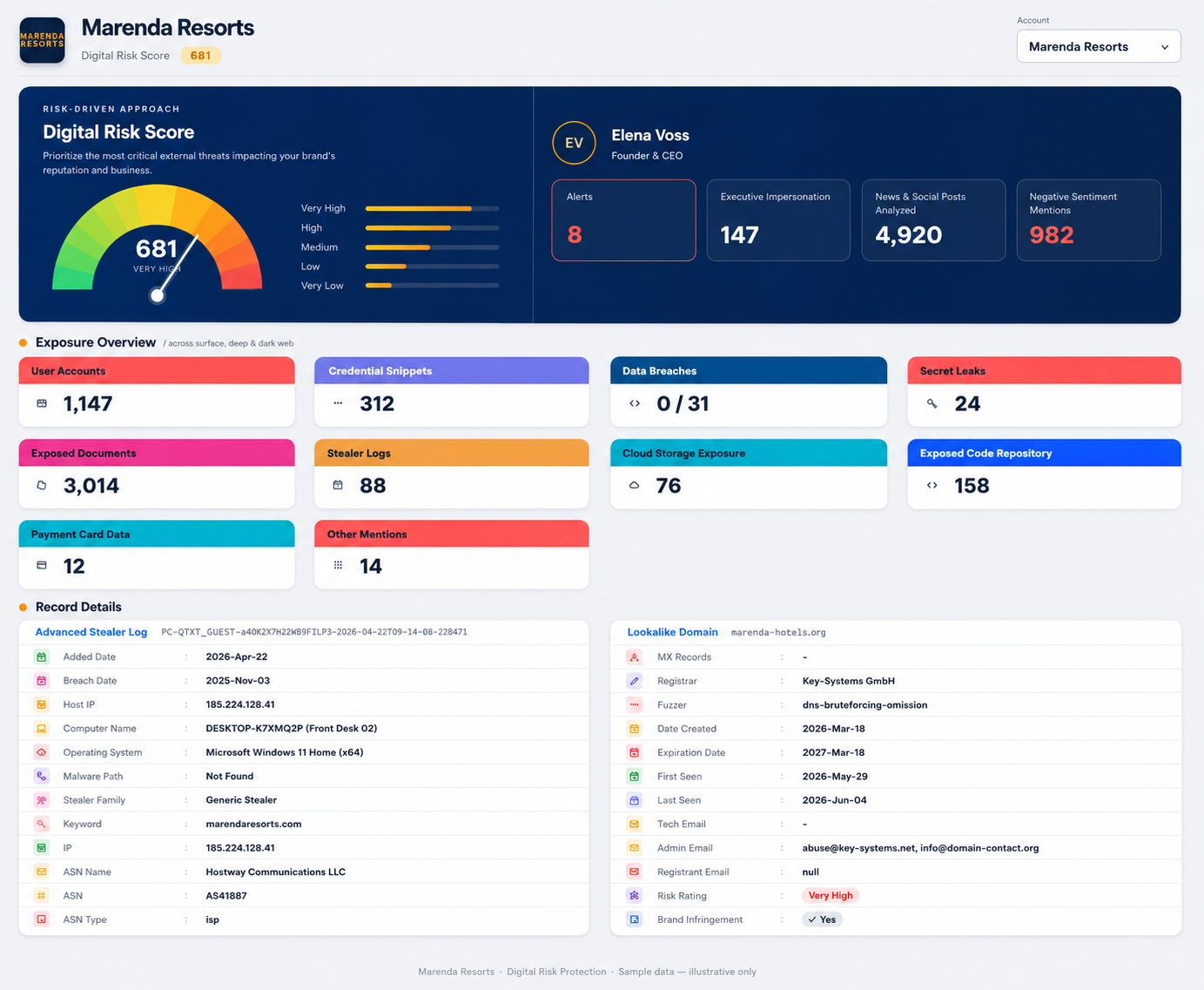
Every finding gets a Digital Risk Score from 0 to 1,000, so your team works the high-risk items first instead of sorting through noise. When something needs to get taken down, Styx Intelligence gathers the evidence and enables you to start and track takedown within the platform.