

Brand trust management for enterprises used to sit mostly with marketing, PR, and legal.
That made sense when the main risk was bad press, customer complaints, or trademark misuse.
That is not the world in which enterprises operate now.
Attackers can damage trust without breaching your systems. They can clone your website, impersonate your executives, create fake social profiles, leak credentials, publish false claims, or use your brand in scams that target customers, employees, partners, and applicants.
That changes the job.
Brand trust is still a business asset. But protecting it now requires security work.
What is Brand Trust Management for Enterprises?
Brand trust management is how an enterprise protects confidence in its name, leaders, digital channels, and customer touchpoints.
For a large company, that means more than brand messaging.
It means knowing when someone is abusing your identity online. It means seeing when your executives are being impersonated. It means finding fake websites, rogue apps, leaked credentials, false narratives, and suspicious mentions before they create wider damage.
In simple terms:
Brand trust management is the work of protecting what people believe about your company and the digital places where that trust gets tested.
For enterprises, those places now include:
- Corporate domains and subdomains
- Login pages and customer portals
- Social media accounts
- Executive profiles
- App stores
- Job boards
- News and community platforms
- Dark web forums and marketplaces
- Third-party systems tied to your brand or customer data
This is why brand trust management now connects to External Digital & Cyber Risk Protection. The threats that damage trust often sit outside the company’s network, across domains, social platforms, app stores, public forums, leaked data, and third-party exposure. Enterprises need a way to see those signals, judge which ones matter, and act before they spread.
This is key: if trust can be attacked outside your network, your trust program needs visibility outside your network.
Why Brand Trust Became a Security Issue
The old model looks like this:
- Marketing built the brand.
- Comms managed the message.
- Legal handled disputes.
- Security-protected systems.
That model breaks when attackers target public trust directly.
What does it mean?
A fake login page is not just a phishing problem. It is also a trust problem. A cloned executive profile is not just a social media issue. It can become fraud, data theft, or public confusion. A leaked credential is not just an access issue. It can help attackers build more convincing scams.
More importantly, the CISO role is changing. Security leaders are still responsible for systems, controls, and incident response. But executives now expect them to understand how cyber risk affects customer trust, brand reputation, and public confidence.
Enterprise security teams are no longer judged only by how they protect servers, endpoints, and cloud systems. They also need to understand how external threats affect revenue, reputation, customer confidence, and executive risk.
FTC data shows why this matters. Impersonation scams were among the top frauds reported to the FTC and caused $2.95 billion in consumer losses. Business and government impersonation scams remain a major part of that problem.
That number does not prove every enterprise needs the same program. But it proves the larger point: impersonation is not a minor brand issue. It creates financial harm, customer confusion, and public trust damage.
Attackers Do Not Need to Break in to Cause Damage
Many enterprise security programs still focus on what happens inside the company.
That matters. But it is no longer enough.
A company can have strong internal controls and still face public-facing abuse that damages trust. A fake domain can collect customer credentials. A fake recruiter profile can target job applicants. A rogue app can copy the brand and steal data. A false claim can spread across social and news channels before the company has a clear response.
Guess what?
None of this happens inside your network or internal systems.
These are external threats. But customers do not care where the attack happened. If your name is on the fake domain, profile, app, or claim, they connect the damage to you. That is why public-facing abuse can hurt trust even when your internal systems were never touched.
As you might remember, the SEC’s X account was compromised in January 2024 and used to publish a false post about Bitcoin ETF approval. The SEC later confirmed that the post did not come from the SEC or its staff. The incident created market confusion and showed how much trust sits in official public channels. Can you see how much impact one compromised public account can create? It’s massive.
That example matters because it was not about a fake website hidden in a corner of the internet.
It was an official public account.
For enterprises, the lesson is that public channels are now part of the risk surface.
What Damages Enterprise Brand Trust?
Brand trust damage usually starts with something that seems small (or you might not even know it exists):
- A domain gets registered.
- A fake profile appears.
- A credential shows up in a leak.
- A rogue app copies your name.
- A false post starts moving through social channels.
- A fake job listing asks candidates for personal data.
Each item may look isolated. However, together they show whether attackers are using your identity and potentially planning a larger attack.
And attackers do not care how your company is organized.
They use whatever part of your identity gives them access, reach, or trust. Your logo, your executives, your hiring process, your customer portal, your vendor relationships, your public accounts, all of it can become part of the same risk.
The most common threats include:
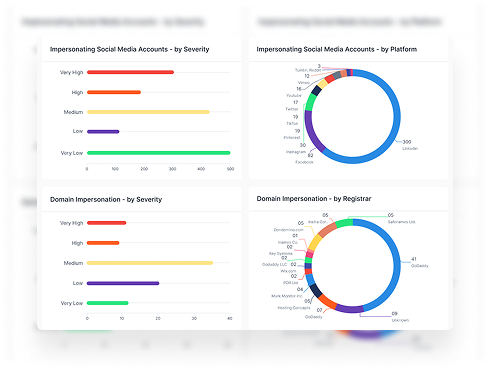
- Lookalike domains: Domains that mimic your company name, product, or login pages.
- Fake websites: Cloned pages that collect credentials, payments, documents, or customer data.
- Impersonated social profiles: Accounts pretending to be your brand, support team, recruiters, employees, or executives.
- Executive impersonation: Fake profiles or messages using leadership identity to influence employees, partners, or customers.
- Rogue apps: Unauthorized apps using your name, logo, or customer trust to drive downloads.
- Fake job posts: Fraudulent hiring pages or messages that target applicants with fee requests, document collection, or malware.
- Leaked credentials: Exposed employee, customer, or vendor credentials that attackers can use for account access or social engineering.
- Dark web mentions: Posts that mention your company, executives, data, credentials, or planned targeting.
- False information: Misleading claims, fake announcements, manipulated content, or coordinated narratives tied to your brand.
- Vendor-related exposure: Third-party breaches, weak vendor systems, or leaked vendor credentials that create risk for your company.
Your attack surface now extends beyond data centers and cloud assets into social media, public accounts, false information, dark web exposure, third parties, and other external places your company does not fully control.
This is why brand trust management cannot stay in one department.
The threat may start in one place, but the impact spreads across security, legal, comms, HR, marketing, fraud, and leadership.
Why Marketing Tools Are Not Enough
Marketing teams already track brand mentions, sentiment, and channel performance. That work matters because it tells you how people talk about your company and where attention is moving.
But it does not answer the questions security needs to answer.
A spike in mentions may be a campaign doing well, or it may be the first sign of a false claim spreading. A new account using your logo may look like a brand issue, or it may be a fake support profile sending customers to a phishing page. A negative post may be a customer complaint, or it may be part of a wider attempt to damage confidence in your company.
Same channel. Different question.
Marketing wants to understand perception. Security needs to understand risk.
That means security needs to ask things like:
- Is this account impersonating us?
- Is this domain built for phishing?
- Is this app unauthorized?
- Is this executive profile fake?
- Is this credential leak useful to attackers?
- Is this social or news activity part of a coordinated campaign?
- Does this finding require legal action, takedown, account reset, customer warning, or internal escalation?
That is why brand trust management cannot rely only on social listening or brand monitoring. Those tools may show that something is being discussed. They do not always show whether it is dangerous, who should own it, or what should happen next.
So, Who Owns Brand Trust Management?
Brand trust attacks do not fit neatly inside one team.
A fake recruiter profile may start with HR, but it can quickly involve brand abuse, applicant data, platform reporting, legal review, and security monitoring. A fake executive profile may look like a comms problem, but it can turn into employee targeting, payment fraud, or customer confusion.
So, who owns brand trust management?
Security should own the risk workflow, not the whole brand.
That means security leads detection, severity scoring, evidence capture, escalation, and technical response for threats that abuse the brand, executives, credentials, domains, apps, and public-facing assets.
Other teams still matter:
- Marketing owns official brand channels and customer clarity.
- Comms owns public statements and narrative response.
- Legal owns enforcement, platform disputes, and trademark action.
- HR owns hiring process clarity and applicant warnings.
- Fraud owns customer scam investigation and response.
The work crosses teams. But someone needs to run the risk process.
What Enterprise Brand Trust Management Should Look Like
A strong brand trust management program does not need to start with a massive rebuild.
It needs 4 basic parts.
Visibility, monitoring, prioritization, and response.
Reporting sits on top of that, so leaders can see what changed, what was handled, and what still needs attention.
1. Visibility
You need to know what exists outside your firewall.
That includes official assets, suspicious assets, and exposed data tied to your company.
Start with:
- Domains and subdomains
- Social accounts
- Executive profiles
- Product names
- Mobile apps
- Customer portals
- Third-party portals
- Public cloud assets
- Credential exposure
- Dark web and forum mentions
- News and social narratives
This gives your team a baseline.
Without that baseline, every response becomes a scramble.
2. Monitoring
At this point, your team is tracking what appears, what changes, what becomes active, and what starts to look harmful.
A lookalike domain may sit parked for weeks, then turn into a fake login page. A social profile may appear empty at first, but then start posting, commenting, and messaging people. A rogue app may show up with limited detail, then update its description, icon, or download path. A leaked credential may appear once, then resurface in another dataset with more useful information attached.
Monitoring helps your team see when something shifts from “watch this” to “act on this.”
For brand trust management, monitoring should track things like:
- New lookalike domains
- New fake or suspicious profiles
- New rogue apps
- New harmful brand mentions
- Changes in sentiment or public conversation
- Dormant assets becoming active
- New credential or data exposure
- Mentions of executives, products, or customer portals
- Vendor exposure tied to your company
- False claims gaining attention
The goal is not to watch everything forever, but to catch the changes that matter.
Monitoring gives your team the context to know the difference.
3. Prioritization
Not every finding deserves the same response.
A parked lookalike domain with no active content is different from a cloned login page collecting credentials. A negative comment is different from a coordinated false claim tied to an executive. A stale credential is different from a fresh stealer log tied to an active employee account.
You get the point…
Your team needs context.
The question is not only, “What did we find?”
The better questions are:
- Who could this affect?
- Is it active?
- Does it collect data, money, credentials, or documents?
- Does it impersonate the company or a leader?
- Is it reaching customers, employees, partners, or applicants?
- What action should happen next?
- Who owns that action?
That is how you avoid treating every alert like a crisis.
4. Response
Detection does not protect trust by itself.
Finding a fake domain, an impersonated profile, a rogue app, or leaked credentials only tells you there is a problem. The next question is what your team does with it.
A response process should make the next step clear:
- Domain takedown
- Social profile takedown
- Rogue app reporting
- Credential reset
- Customer warning
- Employee alert
- Executive protection
- Legal escalation
- Comms response
- Law enforcement report where needed
The goal is to reduce exposure.
If a fake domain is live, the team needs evidence, registrar or hosting details, takedown steps, and blocklist action where needed. If a fake executive profile is active, the team needs platform reporting, evidence capture, internal alerts, and a way to warn people who may be targeted.
This is the workflow enterprises need before something goes wrong. Not after everyone is already asking who owns the response.
Reporting
Reporting is what turns the work into a business conversation.
Executives do not need every screenshot, ticket, or alert. They need to know whether exposure is growing or shrinking, which risks were mitigated, which ones remain open, and where attackers keep coming back.
Useful reporting should show:
- Critical risks found
- Critical risks resolved
- Open risk by severity
- Repeat abuse by channel
- Executive impersonation trends
- Credential exposure trends
- Takedown status
- Average time to detection
- Average time to remediation
- Brand and reputation signals
This is what helps leadership see progress.
It also helps security explain why brand trust management is not just a marketing concern. It is a risk program with signals, owners, actions, and results.
Brand Trust Management Checklist for Enterprises
This checklist is not a full operating plan. Use it as a starting point to understand what your team should protect, what signals to watch, how to judge severity, who needs to be involved, and what to report.
Identify what you need to protect
- Official domains
- Subdomains
- Social accounts
- Executive profiles
- Product names
- Mobile apps
- Hiring channels
- Vendor portals
- Trademarks
Monitor external risk signals
- Lookalike domains
- Fake websites
- Impersonated social profiles
- Executive impersonation
- Rogue apps
- Fake job posts
- Leaked credentials
- Dark web mentions
- False information
- Vendor-related exposure
Define severity
Score findings based on:
- Brand abuse
- Audience reach
- Credential or payment collection
- Executive involvement
- Customer impact
- Employee impact
- Business impact
- Legal exposure
- Active use
- Repeat behavior
Set owners
Assign clear roles for:
- Security
- Legal
- Comms
- Marketing
- HR
- Fraud
- IT
- Executive leadership
Build response paths
Create workflows for:
- Domain takedowns
- Social profile mitigation
- Rogue app takedown
- Credential resets
- Customer warnings
- Employee alerts
- Executive escalation
- Legal evidence capture
- Comms response
- Board reporting
Report the right metrics
Track:
- Risks found
- Risks resolved
- Open risk by severity
- Time to detect
- Time to remove
- Repeat abuse
- Executive exposure
- Credential exposure
- Brand and reputation signals

The Future of Brand Trust Management is Shared Ownership
Brand trust will never belong to security alone.
It should not.
But security now owns an important part of the problem because attackers have changed how trust gets abused.
They do not need to enter your network to create damage. They can target the public places where customers, employees, partners, and investors decide whether your company is safe to trust.
That is why brand trust management for enterprises now belongs inside the broader External Digital & Cyber Risk Protection conversation.
Book a demo to see how Styx helps your team detect, measure, and take down external digital threats before they damage brand trust.