

Modern impersonation attacks spread across domains, ads, social platforms, and news sites before internal tools see anything. By the time a team becomes aware, thousands of people may have already seen or interacted with the fake content.
Here is the problem: Attackers move faster than companies can detect them. And that speed is now the defining factor in how much damage impersonation can cause.
How Impersonation Attacks Unfold so Quickly
Most impersonation attacks follow a predictable pattern, but the speed of each step has increased. Attackers use automation, paid distribution, and public platforms to reach people before any internal alert triggers.
Here is how the workflow actually plays out.
1. Lookalike domains are created instantly
Attackers register several variations of your brand domain at once. Domain registration is immediate and cheap, which gives attackers an instant starting point with no detection barrier.
2. A cloned page is deployed within minutes
Attack kits include ready-made templates that copy login pages, support flows, and brand visuals. Attackers no longer need to design anything from scratch. A convincing page can go live almost immediately.
3. Search poisoning gives attackers immediate reach
Search poisoning is the use of paid ads or manipulated search signals to place the fake site above legitimate search results. This approach is common and effective.
Paid ads make impersonation visible faster than any defensive control.
4. Fake profiles and social content accelerate the spread
Attackers create fake brand profiles, fake executive accounts, or fake support accounts.
These profiles can:
- Reply under your real posts
- Message customers directly
- Promote malicious links
- Announce fake updates
- Run small ad campaigns themselves
Social platforms amplify whatever gets engagement. Attackers use that to their advantage.
5. Messaging apps add more speed
SMS, WhatsApp, Telegram, and Discord give attackers a direct channel to reach victims. These messages are often short, urgent, and easy to believe, especially on mobile, where people are less likely to inspect links.
6. False announcements and misinformation reinforce the attack
Misinformation spreads quickly and often influences decisions before companies can respond.
Attackers use:
- Fake articles
- Fake screenshots
- Deepfake videos
- Manipulated headlines
The scary part is that misinformation attacks can quickly shape public perception.
In most cases, the attack spreads faster than the company can validate what is happening.

Why Detection Speed Matters so Much
Impersonation attacks do not need to stay online for long to create a significant impact. A delay of even one hour can lead to financial loss, customer confusion, and reputational harm.
Here is why timing matters:
- Customers trust what they see first: If the first result on Google or the first reply under your post is fake, people will most likely assume it is real.
- Fake profiles gain legitimacy quickly: Early followers, comments, and interactions give the impersonation more credibility.
- Misinformation becomes harder to correct as it spreads: Platforms amplify engagement, regardless of the “accuracy”. Correcting false posts takes more effort than stopping them early.
- Employees and partners respond to urgent messages without verifying: When attackers pose as executives or support teams, responses come quickly.
All of this means one thing: The faster you detect impersonation, the smaller the impact.
Why Security Teams Struggle with Detecting Impersonation
Companies miss impersonation attacks not because they lack skill, but because they lack visibility where the attacks begin.
Here are the core reasons:
1. Common security tools only monitor internal systems
As you know, impersonation begins outside the network:
- Domains
- Paid ads
- Social platforms
- Messaging apps
- News sites
Internal tools do not see any of this.
2. Unclear who owns external impersonation
Brand, legal, comms, and cyber all play a role. When responsibility is shared but not assigned, response slows down.
3. Verification takes too long
Security teams validate whether a domain is malicious, whether a profile is fake, or whether a post violates policy.
Attackers publish immediately. That timing gap gives them an advantage.
4. Takedown processes are not built for speed
Hosting providers, registrars, and platforms all have different workflows. Many companies try to manage takedowns manually, which slows everything down.
These are some of the reasons attackers move faster than the company can confirm and respond.
What Companies Can Do to Detect and Act on Impersonation Attacks Faster
The only way to reduce the impact is to match attackers’ speed with real-time visibility across the public/external attack surface.
Here is what that looks like:
1. Build a clear inventory of official assets
You need a defined list of your legitimate:
- Domains
- Social profiles
- Executive profiles
- Communication channels
- Apps
- Third-parties
This becomes your reference point to spot what does not belong.
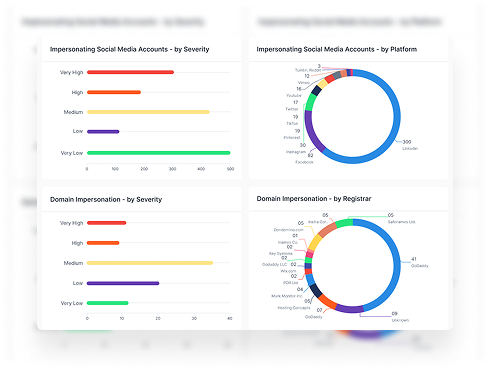
2. Monitor domains, social platforms, dark web channels, and news in real time
This is the foundation of fast detection. You cannot act on threats you cannot see.
Your monitoring should capture:
- Newly registered lookalike domains
- Evil twin websites built on those domains
- Fake executive or brand profiles
- Sudden spikes in negative or misleading content
- Unauthorized logo use or brand copy
- False announcements or news stories
- Mentions on Telegram, forums, or dark web markets
The goal here is to detect the threat as soon as it appears, not days later.
3. Filter and score threats so your team knows what to respond to first
Monitoring creates a constant stream of signals. You need a way to prioritize them so your team focuses on the issues that can cause the most damage.
A scoring model should highlight:
- Impersonation of executives or official channels
- Fake profiles with engagement
- Fraudulent support pages
- Domain clusters tied to phishing infrastructure
- Posts that show signs of scams, hate, threats, or leaked information
- False announcements that could influence customers or investors
This is not automation for the sake of automation. It is triage, helping your team understand which alerts require immediate action and which can wait.
Prioritization and speed are what reduce exposure.
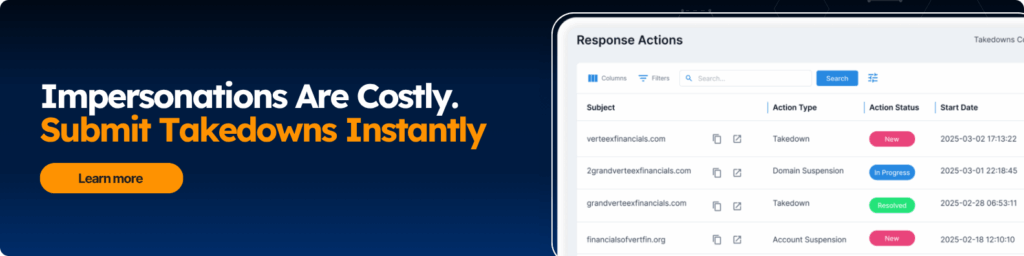
4. Integrate takedowns into incident response
Takedowns need to be part of your response playbook, not a side task owned by one team. Taking down lookalike domains, impersonated profiles, and fake job posts early reduces the number of people who see them and the damage they can cause.
A good takedown workflow includes:
- Clear criteria for abuse
- Evidence captured as soon as the threat appears
- Direct paths to registrars, hosting providers, and platforms
- Escalation between security, legal, and communications
A Final Thought
Impersonation attacks spread quickly because they start on platforms designed for speed (social media, for example). Attackers rely on visibility long before teams see an alert or receive a report from a customer.
If you want to reduce the impact, you need real-time visibility across the external channels where these attacks begin. As you read today, speed is foundational if you want to stay ahead of impersonation.
See how Styx provides real-time detection across domains, social platforms, news, and dark web forums — all in one platform.