

Security teams spend years building defences around the systems they own, inside the organization. However, attackers changed direction.
They no longer need to breach your network to harm you or your business. They now target your brand’s and leaders’ identities… and these identities live outside your perimeter.
This is the shift most companies have not adapted to.
Identity is now the easiest way to attack your organization.
The Shift Attackers are Making
For years, lookalike domain was the most common way to mimic a company, and although it’s still happening, the trend is changing.
Attackers realized something more valuable and easier to weaponize: executives and brands.
Executives and brands are public. Your official logo, your imagery, your company name, your voice, your style, your colour palette, your executives’ photos, and every message you publish online can be copied without effort.
An attacker does not need technical skills anymore. They need content, and guess what? You are giving them all the content they need.
Identity impersonation is growing at a speed most teams are not ready for.
Why Identity is Now More Valuable than a Domain
Attackers used to rely on domains because they were simple, cheap, and predictable. But identity (people and brands) now gives attackers more leverage with less effort. The motivations are different depending on the target, so it helps to break them apart.
Executive identity: high authority with low resistance
Executives give attackers something domains never could: direct influence over people who make quick and important decisions.
Here’s why executive identity is so valuable:
1) High authority
Executives can approve payments, share sensitive info, influence plans, and trigger internal action.
When a message appears to come from them, people act quickly.
2) Clear digital footprints
Executives publish interviews, talks, videos, and personal posts.
Attackers use this public material to craft convincing deepfakes.
3) People rarely question leadership
Employees and partners typically do not push back when they believe a CEO or CFO is making a request.
Attackers exploit this trust.
4) AI makes impersonation easy
Voice cloning and deepfakes reduce skill barriers. Anyone can generate content that looks and sounds real.
5) Urgency increases success
Most executive impersonation attacks rely on time-sensitive asks: Payments, sensitive updates, or confidential files.
Urgency gives attackers an advantage.
The bottom line?
Executive identity gives attackers credibility, speed, and emotional pressure, things a domain cannot provide.
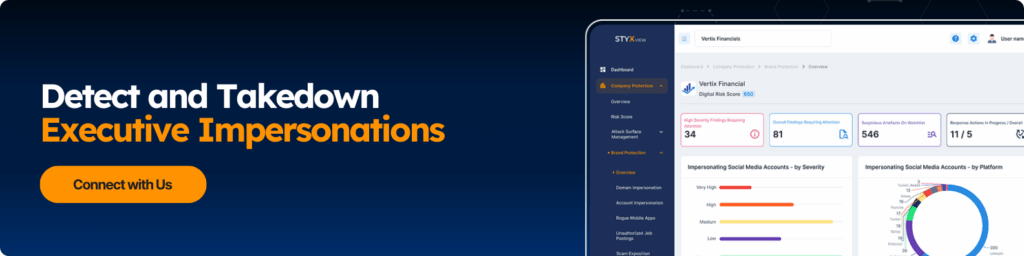
Brand identity: large reach and immediate trust signals
Brand identity is the face of the company, and customers trust it, follow it, and react to it. This makes brand impersonation efficient for wide-reaching scams.
Even though lookalike domains are part of some brand impersonation attacks, the power comes from copying the brand’s identity (logo, colours, typography, etc), not only the URL.
Here’s why brand identity is now more valuable than a lookalike domain:
1) Customers trust what looks familiar
If a social media account, ad, or storefront uses your logo, colours, or messaging style, people assume it is official.
Attackers rely on that instinct.
2) Brand assets are easy to copy
Logos, fonts, colours, product photos, and support templates are all public.
Recreating them takes minutes.
3) Scams scale with paid ads
Attackers buy ads that impersonate your brand and reach thousands of people before you even see the activity.
4) Search and social media engines surface fake content
Impersonated brand pages often outrank official ones for short periods, especially during campaigns or promotions.
This drives users directly into scams.
Customers will enter credentials, make purchases, and share personal info if the experience looks like your brand.
Domain names alone do not have this power.
6) Brand impersonation supports every other scam
Fake brands help attackers amplify:
- phishing sites
- counterfeit stores
- fake customer support
- fake job listings
- investment scams
- deepfake executive messages
Brand identity gives attackers reach, credibility, and conversion — things a domain alone cannot achieve.
Why Domain Abuse is Levelling Off
Domain-based impersonation is still common, but the advantage attackers once had is shrinking.
Companies now use:
- Domain monitoring tools
- Stronger DMARC policies
- Faster takedown processes
- Better awareness of lookalike domains
- Clearer communication with customers
Attackers know they will be detected.
They know takedowns happen faster, or domain reputation systems catch them sooner.
A lookalike domain can still work on its own, but the identity impersonation is what makes it dangerous.
Why Identity Impersonation is Accelerating
Identity-based attacks cost less to launch, scale easily, and bypass traditional security controls.
These are the three major trends that drive the acceleration.
1. Public digital footprints keep expanding
Executives and brands produce more content than ever, and everything is indexed, searchable, and reusable.
This gives attackers endless raw material.
2. AI tools reduce skill requirements
Voice cloning, deepfake video, image generation, logo recreation, and copy mimicry take minutes. Attackers no longer need expertise. They only need access to basic tools.
3. The ownership of “identity protection” is unclear
Could you answer these questions?
- Who protects executive identity?
- Who protects brand identity outside corporate channels?
- Who owns impersonation on social platforms?
- Who monitors fake content on news sites?
Most companies cannot answer them, so attackers exploit that gap. This is also why even the CISO role will need to adapt to this shift.
Examples of These Two Identity-Based Attacks
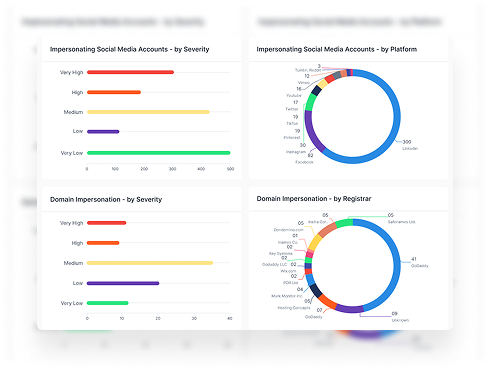
Identity-based attacks fall into two main categories.
Both are growing, and both require early detection.
1. Executive identity impersonation
This includes:
- Fake executive profiles
- Deepfake audio
- Deepfake video
- Fake updates or announcements
- Fake hiring outreach
- Requests that appear to come from leadership
Attackers use these tactics to move money, collect credentials, or push false narratives.
2. Brand identity impersonation
This includes:
- Fake brand pages
- Unauthorized use of your logo or visual identity
- Fake support accounts
- Lookalike stores
- Fraudulent paid ads
- Phishing websites
- Misleading press releases
- Fake job postings
- Counterfeit product sites
These attacks target your customers and your reputation. They erode trust, create confusion, and damage the brand you are trying to protect.
How do they usually do it?
Attackers often combine both in a single campaign.
- A fake executive post drives traffic to a fake brand page.
- A fake brand page shows a deepfake video of an executive.
- A fake domain hosts a fake support portal tied to a fake social account.
This is why identity is now the root of the attack surface.
What this Shift Means for Digital Risk Protection
Digital Risk Protection used to focus almost entirely on infrastructure:
- Domains
- Subdomains
- Certificates
- DNS changes
- URLs
That is no longer enough.
Today, DRP must include:
- Executive identity
- Brand identity
- Social media identity
- Search visibility
- Paid ads
- News coverage
- Public sentiment
- Misinformation
- Deepfake content
- Unauthorized use of visuals
- Telegram and dark web mentions
- Fake apps
- Fake job listings
The attack surface expanded beyond anything a single team can manually track.
What is the problem?
- Old tools do not monitor these areas.
- Old playbooks do not cover these threats.
- Old structure does not define who owns identity protection.
This is why identity must now sit at the centre of DRP, not at the edges.
What Companies Need to Prioritize
To protect identity, companies need three things: visibility, detection, and action.
1. Understand what is public
Audit all public identity assets:
- Executive bios
- Social media profiles
- Brand assets
- Logos
- Images
- Company descriptions
- Domain and subdomains
- Support pages
- Press releases
You must know what is yours (and real) before you try to detect what is fake.
2. Monitor identity in real time
You need early signals when:
- A fake profile appears
- A fake domain uses your brand
- A deepfake clip circulates
- A false announcement is published
- Your logo is used without permission
- A job scam mentions your name
- A support scam uses your identity
- Conversations about your company turn negative
- Unknown sources start targeting executives
A platform should alert you as soon as identity misuse appears anywhere across social, news, search, dark web, or messaging channels.
3. Detect harmful content early
Visibility is not useful without action. The value comes from identifying what matters:
- Impersonation
- Fraud
- Scam patterns
- Hate or targeted threats
- Misinformation
- Deepfake distribution
- Unauthorized use of your brand
- Leaked internal information
Early detection helps you respond while the issue is small, before the narrative spreads.
4. Respond and take down threats with coordinated action
Identity threats require collaboration across:
- Security
- Communications
- Legal
- Brand
- HR
- Finance
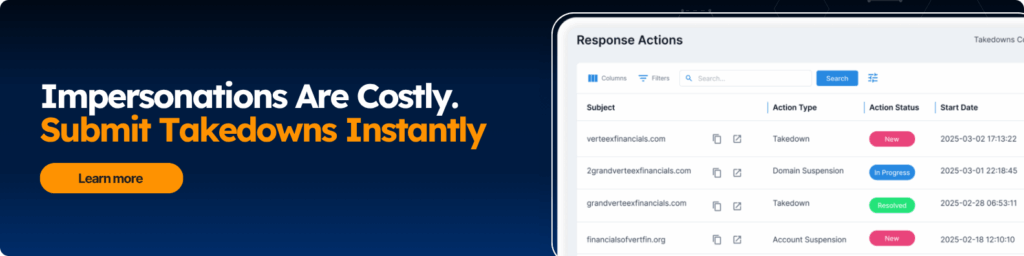
Teams need a clear escalation path, a takedown process, and a verified communication plan.
Final Thoughts
Attackers now go after the identity of your organization, not only its systems.
They impersonate the people who represent your company and the brand your customers trust.
They use public platforms, AI tools, and misleading content to influence decisions, redirect money, and damage reputation.
Defending your company now means defending your identity. This includes your executives, your brand, and every public signal tied to your name.
If you want to protect your identity across the “public” attack surface, you need a single platform that gives you visibility across executive risks, brand misuse, lookalike domains, social media threats, external attack surface changes, dark web, and third-party exposure.
Book a demo to see how Styx brings all of this into one place, so you can detect impersonation and identity-based threats before they reach your customers.