
External Attack Surface Management
Why External Attack Surface Management (EASM) Matters More Than Ever
Styx Team · · 3 min read
Updated

Key Takeaways
- Map & verify: Auto-inventory internet-facing assets and shadow IT; tag owner, environment, and criticality.
- Monitor & prioritize: Track new assets, misconfigs (open ports, TLS/DNS), leaked credentials, and lookalike domains/profiles; risk-score by exploitability and business impact.
- Remediate & prove: Fix or take threats down fast, prevent reappearances, and show trend lines to leadership.
- Summarize the article with
Summarize this article with:ChatGPTGeminiPerplexityClaudeGrok
Today, your digital footprint is bigger than you think.
It now includes:
- Social media accounts
- SaaS platforms
- Cloud infrastructure
- Forgotten assets, and
- Third-party services
All of which can be targeted by attackers.
External Attack Surface Management (EASM) gives security teams visibility into what attackers see — and what they’re most likely to target. More importantly, it delivers continuous monitoring — not point-in-time snapshots.
That makes EASM a must for any proactive security program — and a core building block of modern Continuous Threat Exposure Management (CTEM).
How EASM Supports the First Three Phases of CTEM
Effective Continuous Threat Exposure Management (CTEM) starts with visibility. EASM provides the foundation by powering the first three phases:
- Scoping: Identify all internet-facing assets, domains, SaaS tools, and digital exposure points.
- Discovery: Uncover misconfigurations, leaked credentials, impersonations, and vulnerable services.
- Prioritization: Focus on the most visible and high-risk exposures that are likely to be exploited.
This approach forms the foundation of real-world risk reduction — not just security ratings.
Your Exposure Isn’t Just IT Infrastructure Anymore
An organization’s digital footprint is dynamic. It grows fast — and often without anyone noticing. External exposure today includes far more than servers and endpoints.
Here’s what’s showing up:
- Brand abuse: Spoofed domains, cloned social media accounts, misleading ads. If you want to learn more about brand protection, check out this article.
- Unapproved SaaS apps (Shadow IT): Tools deployed outside IT governance.
- Forgotten assets: Unused cloud instances, dev environments still live.
- Leaked credentials: Login data published online, accessible to attackers. Data leakage and dark web monitoring can help address this issue.
- Targeted personnel: Executives and employees impersonated in phishing campaigns. Learn everything you need to know about executive impersonation here.
If you’re not tracking these, attackers probably are.
Start your free trial here (no credit card required).
EASM vs. Vulnerability Assessments and Penetration Tests
Traditional vulnerability assessments (VAs) and penetration tests are valuable — but they’re point-in-time exercises, limited in scope and frequency. They’re often internal or network-bound and don’t account for your entire digital footprint.
EASM fills that gap with:
- Continuous, automated scanning of the public-facing attack surface.
- Real-time alerts on asset changes, new exposures, and emerging threats.
- Contextual visibility into external threats that go beyond internal infrastructure.
In short: EASM doesn’t replace VA or pen testing — it fills the blind spots they miss.
What a Mature EASM Program Should Deliver
A solid EASM program goes beyond surface scans. It gives teams a clear picture of real-world exposure — and the tools to act on it.
Here’s what that should include:
- Discovery of all internet-facing assets: Domains, social media assets, cloud services, mobile apps, and unauthorized SaaS tools.
- Brand abuse detection: Across social media, app stores, and third-party platforms.
- Monitoring of misconfigurations and exposures: Including insecure ports, SSL/TLS errors, and DNS issues.
- Detection of leaked credentials and impersonations: Across paste sites, forums, and dark web sources.
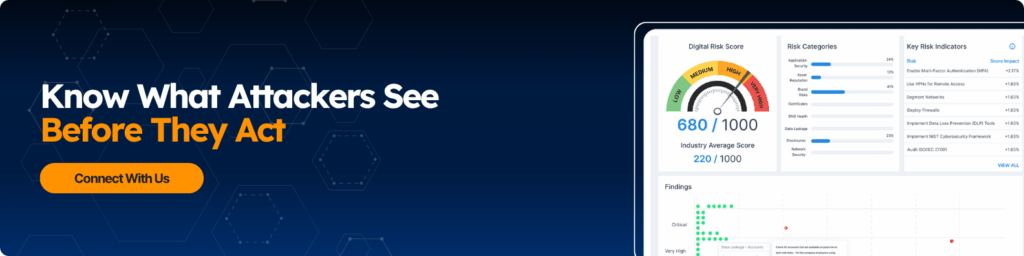
- Digital Risk Scoring: To track exposure over time and prioritize remediation (this is key).
- Dashboards for technical and executive teams – To monitor trends, risks, and performance metrics.
- Takedown support: To remove spoofed domains or impersonating accounts quickly.
This provides operational clarity and decision-making confidence, based on live, external data.

The Value of Digital Risk Scoring
A Digital Risk Score turns raw exposure data into something you can use. It helps you:
- Quantify your current external risk posture.
- Track improvements over time.
- Align cybersecurity efforts with business priorities.
- Justify budgets and strategic decisions with measurable impact.
This is how EASM becomes more than alerting. It becomes strategic.
Do you know how a digital risk score actually works? Here are the “secrets” of the risk scorecard explained.
Final Takeaway
Most organizations are more exposed than they realize. If you’re not continuously identifying and addressing what’s visible to attackers, you’re not managing risk — you’re accepting it.
EASM gives you complete visibility, real-time insights, and data-driven control over your external attack surface. It doesn’t replace your internal security stack — it complements and strengthens it, ensuring no blind spots go unnoticed.
EASM provides continuous, actionable protection.
Want to see what attackers see?
Book a demo to learn how Styx helps you track digital exposure, leaked credentials, and brand threats — before they turn into incidents.
Protect your leaders with Styx Intelligence
Talk to UsRelated articles

Digital Footprint Management: What It Means for Security Teams
What Is a Digital Footprint in Cybersecurity? Your digital footprint is every online asset, account, system, and data trail tied to your company. That includes the assets your team owns directly, such as: It also include
Jun 5, 2026 · 9 min read

The Perimeter Moved: Your External Attack Surface in 2026
Is Your Security Budget Where The Risk Actually Is? Most security money stacks up inside the network. A disproportionate amount of budget today goes entirely to endpoint protection, network security, and building out the
Jun 3, 2026 · 6 min read

Pretexting: How Attackers Use Your Public Footprint Against Your Team
What is Pretexting in Cybersecurity? Pretexting is a type of social engineering where someone invents a story to trick a person into giving up information, money, or access. The story drives the attack. Remember, the att
May 26, 2026 · 9 min read