Digital Risk Protection
Digital Risk Protection: Comparing 6 DRP Tools (and Which Ones Actually Fit Lean Teams)
Meredith Gray · · 8 min read
Updated

Key Takeaways
- Most digital risk protection platforms are built for enterprise SOCs. The assumption of dedicated analysts, triage capacity, and a six-figure budget is baked into the product, not just the price tag.
- Coverage breadth and usability pull against each other: Cyble spans threat intel through EDR but generates alert volume a 1-5 person team can’t triage, while BrandShield goes deep on marketplace and counterfeit abuse but narrow everywhere else.
- The gap isn’t detection, it’s ownership. Automation-first tools like Bolster surface findings fast but leave interpretation to you; the differentiator for lean teams is whether someone outside your headcount owns the outcome through to a verified takedown
- Styx Intelligence was designed for lean security teams with analyst-backed protection and AI-powered detection.
- Summarize the article with
Summarize this article with:ChatGPTGeminiPerplexityClaudeGrok
Key Features
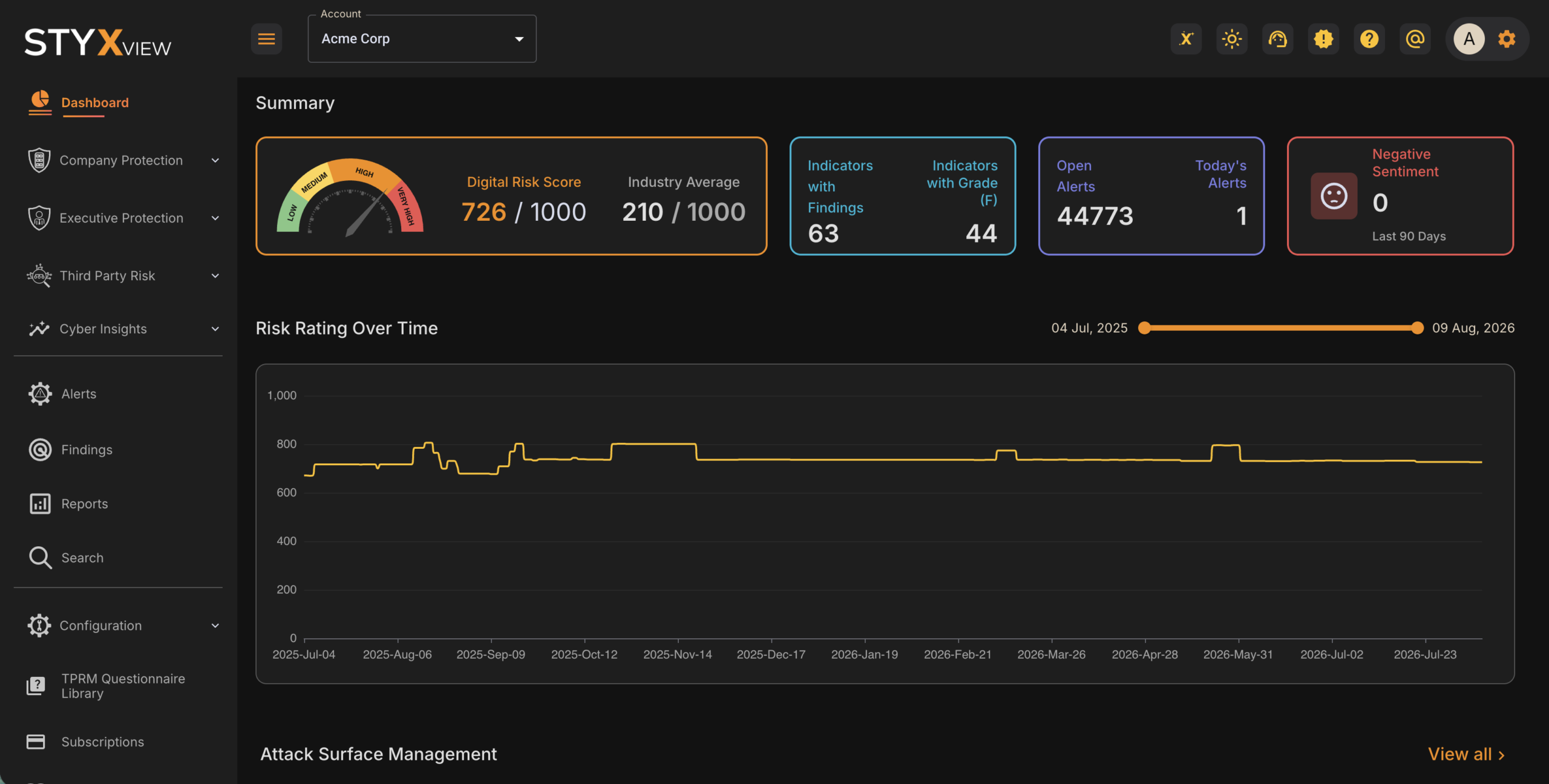
Styx covers the full external risk surface in one platform:
- Attack surface management: mapping domains, social accounts, and exposed assets before attackers find them
- Brand monitoring and takedowns: detecting lookalike domains, fake social profiles, and impersonation, then performing verified takedowns rather than just alerting on them
- Executive protection: monitoring for deepfakes, impersonation, and personal data exposure tied to leadership
- Data leakage and dark web monitoring: tracking leaked credentials and shadow IT exposure across unmanaged tools and accounts
- Third-party vendor risk: monitoring the vendors and partners your own security team doesn’t directly control
The differentiator worth calling out: Styx pairs AI-powered detection with a dedicated analyst who owns the outcome, not just the alert. Verified takedowns and measurable exposure reduction are part of the delivery model, not an add-on.
Best Fit
Styx is built for security teams of 1-5 people at mid-sized organizations who need enterprise-grade external visibility but don’t have an enterprise-sized team or large budget to run it themselves. To be upfront about the trade-off: we’re built around an analyst-backed model, so a large enterprise that specifically wants to run detection and response entirely in-house, with no analyst layer and full internal control, will likely find this more structure than they need.
Pricing
Pricing can be highly customized to meet your needs. Plans are scoped to organization size and coverage needs, allowing your coverage to grow and scale as your footprint does.
To get a sneak peek into your external threat exposure, get a free risk report to see where your organization currently stands. From there, our team can walk you through the report and show you further details.
Platform #2: BrandShield
BrandShield is an AI-powered brand protection platform focused primarily on marketplace, counterfeit, and domain abuse detection.
Key Features
BrandShield’s product suite centers on online brand protection and external cybersecurity, with hybrid enforcement combining AI detection and human takedown teams. Its strongest documented use cases are marketplace counterfeit removal and IP infringement, drawing heavily from retail and e-commerce customer stories.
Best Fit
Brands with a significant counterfeit or marketplace abuse problem, and IP or legal teams that need enforcement support alongside detection, particularly in retail, consumer goods, and e-commerce. The trade-off is that coverage skews narrower and more marketplace-focused than a full DRP suite, so if your exposure is more about executive impersonation, third-party risk, or attack surface visibility than counterfeit goods, you’re paying for depth in an area that may not be your biggest problem. Public G2 reviews also note the pricing structure tends to suit larger organizations better than smaller ones (G2, BrandShield product reviews, 2026).
Pricing
BrandShield does not publish their pricing or any additional details on their plan structure.
Platform #3: Bolster AI
Bolster is an AI-powered platform focused on automated detection and takedown of phishing sites, fake mobile apps, and social media impersonation.
Key Features
Bolster’s platform detects fraudulent websites, counterfeit mobile apps, and impersonation across social channels, with an emphasis on speed and automation. The company has publicly stated its automated approach can reduce cost per takedown significantly compared to manual processes.
Best Fit
Enterprise brands in sectors like financial services and retail that want heavily automated detection and takedown with minimal manual review, and that already have the internal capacity to interpret automated findings without needing the platform to explain its own reasoning.
The trade-off: public G2 reviews describe Bolster’s automated decisioning as a “black box,” with limited visibility into why a given alert fired the way it did. For a one-or-two-person security function without spare time to build that context themselves, it can mean more second-guessing than the automation saves.
Pricing
Bolster does not publish their pricing or any additional details on their plan structure.
Platform #4: Cyble
Cyble is one of the broadest platforms on this list, spanning threat intelligence, dark web monitoring, brand intelligence, attack surface management, third-party risk, and even endpoint detection and response under one umbrella, positioned as “AI-native cyber defense.”
Key Features
Cyble’s flagship Cyble Vision platform covers real-time threat intelligence and dark web monitoring, with newer additions like Cyble Blaze AI, an autonomous investigation agent, plus deepfake and executive impersonation detection.
Best Fit
Large enterprises, government agencies, and SOC teams that have dedicated analysts and want one platform spanning threat intel through EDR. The trade-off is that this breadth generates volume: public G2 reviews mention alert volume and false positives that require real time to triage, and support response during urgent situations has been a point of friction for some users (G2, Cyble product reviews, 2026).
For a 1-5 person team, a platform this broad can mean more surface area to manage than there’s time to act on.
Pricing
Cyble does not publish their pricing or any additional details on their plan structure.
Platform #5: SOCRadar
SOCRadar positions itself as an Extended Threat Intelligence (XTI) platform, combining cyber threat intelligence, attack surface management, and digital risk protection.
Key Features
SOCRadar’s platform includes vulnerability intelligence, dark web intelligence, threat hunting, threat actor monitoring, and a malware analysis sandbox, modular enough that customers can scope coverage to their needs.
Best Fit
Small and mid-sized businesses that want to try a platform themselves before committing to a bigger, managed relationship. SOCRadar is the only platform on this list with genuinely public pricing, a real free tier plus a published paid plan, so a team can start testing without a sales conversation first. The trade-off is that self-serve means self-managed: SOCRadar’s entry tiers are built around access to feeds, credits, and hunting rules that a lean team still has to operate and interpret themselves, there’s no dedicated analyst layer owning the outcome the way there is with tools like Styx Intelligence.
Pricing
SOCRadar offers a genuine free tier, plus a paid “Essential” plan starting at $14,750 per year for one seat, basic cyber threat intelligence. Pricing increases if you would like to ensure that all attack surfaces are monitored.
It’s worth noting that even the most transparent pricing on this list still represents a meaningful annual commitment for a one-or-two-person security budget.
Platform #6: Check Point Exposure Management (formerly Cyberint)
Check Point Exposure Management, the product formerly known as Cyberint, is an enterprise external risk management platform that combines threat intelligence, brand protection, and attack surface management with expert analyst support.
Key Features
The platform monitors domains, IPs, applications, social channels, and trademark use, and includes analyst-led forensic investigation for more sophisticated attacks. Response and investigation work is metered through a consumption-based credit system.
Best Fit
Enterprises that want a fused threat intel and brand protection platform backed by expert analysts, and that have the budget and internal process maturity to manage a consumption-credit model for takedowns and investigations.
The trade-off is real cost: all tiers require a custom quote, and public G2 reviews describe it as “a premium enterprise solution” where “the licensing can be expensive,” with smaller organizations often finding the price point high (G2, Check Point Exposure Management reviews, 2026).
Pricing
No public pricing; all tiers require a custom quote, metered through a consumption-based credit system.
Quick Comparison
| Platform | Best For | Ideal Team Size Fit | Pricing Model |
|---|---|---|---|
| Styx Intelligence | Lean teams needing full coverage plus a dedicated analyst support | 1-5 person security team | Flexible, grows with your organization |
| BrandShield | Marketplace and counterfeit-heavy brands | Larger teams, per G2 reviews | Unknown |
| Bolster AI | High-automation phishing and impersonation takedowns | Enterprise, automation-forward teams | Unknown |
| Cyble | Broad enterprise coverage, threat intel through EDR | SOC teams with dedicated analysts | Unknown |
| SOCRadar | Self-serve testing before a bigger commitment | Any size team with dedicated resources to manage threats internally. | Free tier + several levels depending on types of threat protection. No unified platform pricing listed. |
| Check Point Exposure Management | Enterprise, analyst-led investigations | Large enterprise with budget for consumption credits | Unknown |
Which DRP Tool Fits Your Team?
The honest answer depends less on features and more on team size and maturity.
If you’re a one-to-five person security team at a mid-market, regulated organization that needs enterprise-grade visibility across brand, executive, and third-party risk, without the enterprise headcount or budget to run it, that’s the specific gap Styx Intelligence was built to close: AI-powered detection paired with a dedicated analyst who owns the outcome, not just the alert.
See where your organization currently stands. Get your free risk report and get key insights into your organization’s external risk posture in minutes.
Sources: Gartner (global infosec spending, 2026); G2 and Gartner Peer Insights (vendor ratings and review excerpts, 2026); individual vendor sites (feature and pricing details, accessed August 2026); Forrester, “Tech Security 2026 Predictions”, October 2025.
Phishing sites found, filed, and taken down by Styx
Book a demoRelated articles
Why Cybersecurity Teams Need a Proactive Approach… Not a Reactive One
A proactive approach is the difference between stopping risk early and cleaning up damage later. Most security teams still act only after something breaks, but today’s attacks start long before any alert is triggered. Th
Jan 16, 2026 · 9 min read
Identity and the New Attack Surface: Why Attackers Now Target People and Brands
Security teams spend years building defences around the systems they own, inside the organization. However, attackers changed direction. They no longer need to breach your network to harm you or your business. They now t
Dec 16, 2025 · 7 min read
The Future of the CISO Role: Brand Trust and External Threats
Most security leaders still measure their work in alerts, incidents, and controls. That work matters, but it is no longer the main thing your company expects from you. The next stage of the CISO role has nothing to do wi
Dec 4, 2025 · 7 min read