
Brand Protection and Takedowns
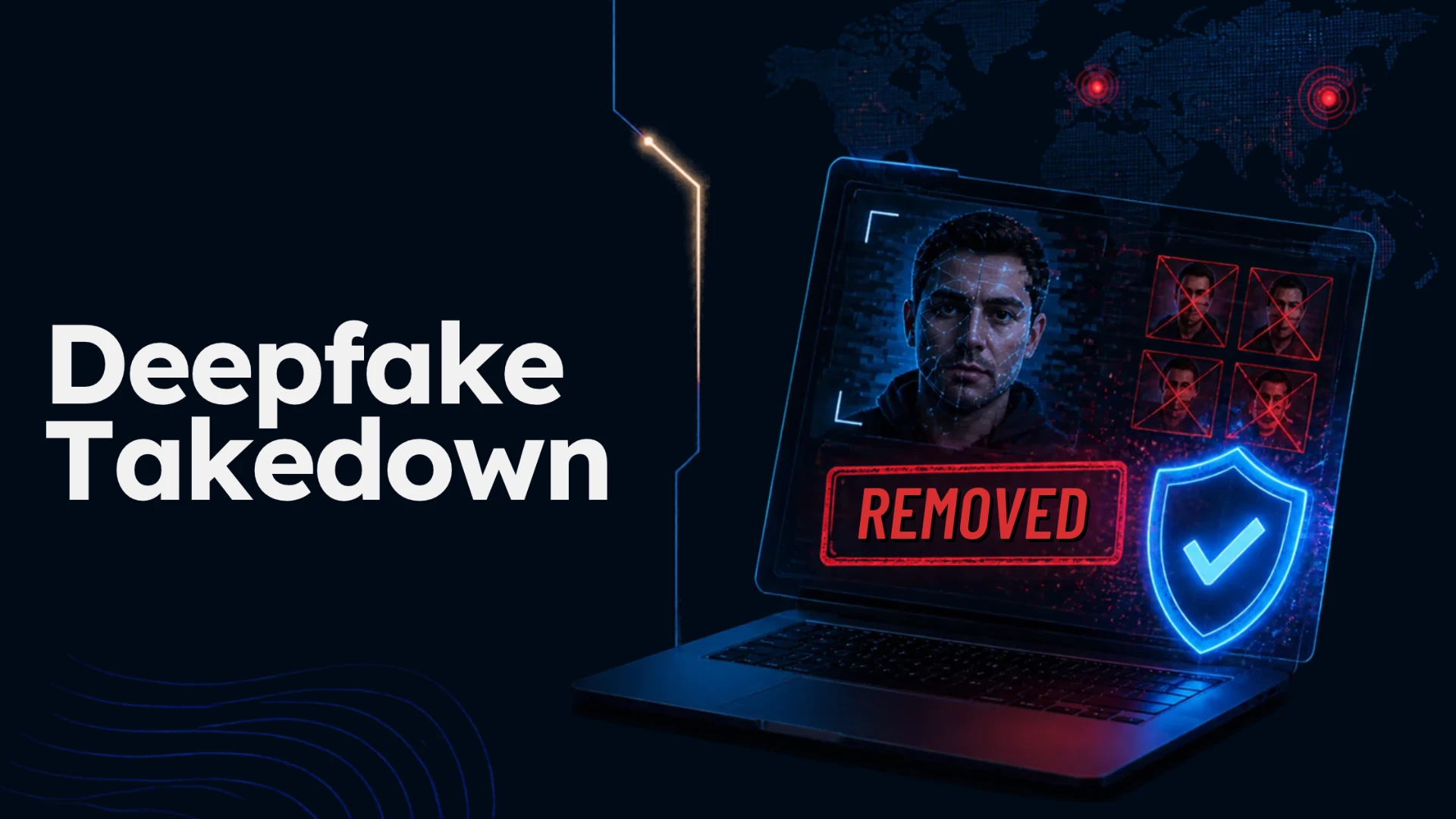
Deepfake Takedown: How to Remove AI Impersonation and Deepfake Phishing Content
Meredith Gray · · 6 min read
Summarize this article with:ChatGPTGeminiPerplexityClaudeGrok
A deepfake takedown removes the synthetic video, cloned-voice clip, fake profile or phishing page that impersonates your organization or one of its leaders. The fastest route is rarely proving that the content was made with AI. It’s showing the platform or host that the content impersonates a real person or organization, uses someone's likeness without consent, or supports fraud. This guide explains what can be removed, which policy grounds the major platforms enforce, who has to file, and the steps that work.
Key takeaways
- Platforms remove deepfakes under impersonation, privacy, endorsement and fraud rules. "It was made with AI" is rarely enough on its own.
- Who files matters. YouTube's complaint process for AI-generated likeness must come from the person shown or their legal representative.
- A takedown removes the asset, not an attack already in progress. A live deepfake call cannot be taken down; verification procedures handle that risk.
- Deepfake phishing usually travels with ordinary infrastructure: a lookalike domain, a spoofed site, a fake account. Remove those too.
- Capture evidence before you report, because reported content can disappear and reappear somewhere else.
What a deepfake takedown can and can't remove
A takedown works on content that is hosted somewhere: a platform, a website, an ad network or an app store. That covers most of the assets used in deepfake phishing:
- Uploaded media: synthetic video or audio posted to a social or video platform.
- Accounts and profiles: accounts that use a real person's name, photos or a synthetic likeness to pose as them.
- Websites: pages that host the deepfake or collect data and payments from people it persuades.
It doesn’t work on an interaction that is happening live. In December 2024, the FBI warned that criminals "generate videos for real time video chats with alleged company executives". No platform report ends a call that is already under way; that risk is handled by verification rules, covered below.
Where deepfake phishing content actually lives
Deepfake phishing is rarely a single file. In fact, public warnings describe a chain of assets:
- Cloned voices. The FBI reports criminals using AI-generated audio clips to impersonate relatives and to gain access to bank accounts.
- Synthetic video on social platforms, pointing to a spoofed site. In July 2026, an FBI alert warned of AI-generated videos depicting a senior FBI leader encouraging users to submit complaints, paired with a spoofed site with "similar structure and content" to the real IC3 site that collected names, phone numbers, email addresses and loss estimates.
- Synthetic identity material in financial fraud. FinCEN reported that "beginning in 2023 and continuing in 2024" it observed an increase in suspicious activity reports describing the suspected use of deepfake media.
For a security team, the practical point is that each link in that chain is a separate removal: the video, the account that posted it, and the site it sends people to.
Why "it's AI" is rarely the strongest argument
Most platform rules do not ban synthetic media outright. They ban specific harms, and the report has to name the one that applies.
- YouTube considers whether the content is altered or synthetic, whether that is disclosed, whether the person can be uniquely identified, whether it is realistic, whether it has parody, satire or public interest value, and whether it shows a public figure endorsing a product or in other sensitive behavior, according to its Protecting your identity help page.
- X enforces a Misleading and deceptive identities policy. Accounts found in violation "will either be suspended or asked to update the account(s) so they no longer violate our policies".
- TikTok states in its Integrity and Authenticity guidelines that it does not allow synthetic media containing the likeness of a real private figure, or synthetic media of an adult public figure "when used for political or commercial endorsements".
So a report that leads with "this is a deepfake" asks the reviewer to make a judgment the policy may not require. A report that leads with "this account impersonates our CFO and promotes a fake investment" maps directly to a rule.
| Platform | Strongest policy ground for a deepfake | Who can file | Source |
|---|---|---|---|
| YouTube | Realistic altered or synthetic likeness of an identifiable person (privacy complaint) | The person shown or their legal representative | YouTube Help |
| X | Misleading and deceptive identities (impersonation); trademark or brand misuse | The person or an authorized representative; bystanders can flag; companies file a brand complaint | X Help Center |
| TikTok | Synthetic likeness of a private figure; synthetic public figure used for endorsements; impersonation | The person, an authorized representative, or the brand or organization (online form, ID required); anyone can flag an account in the app | TikTok report form |
| Websites | Phishing, fraud or trademark abuse reported to the host and registrar | Any affected party, with evidence | How phishing website takedowns work |
The deepfake takedown process, step by step
- Capture evidence first. Record the URL, the account name and any account ID, screenshots, the time you found it, and where it was shared.
- Map the asset and what surrounds it. Note whether you are dealing with platform-hosted media, an impersonating account, a website or a combination. Follow every link the content points to.
- Choose the policy ground the platform enforces. Impersonation, unauthorized likeness, fraud or a fake endorsement. Use the platform's own wording in the report.
- File as the right party. On YouTube that means the person shown or their legal representative. On X it means the person, an authorized representative, or the company for brand misuse.
- Take down the infrastructure around it. A deepfake that sends people to a lookalike domain needs a registrar and hosting report as well. The process is the same as any phishing website takedown.
- Warn people while the content is live. Tell employees and customers what your leaders will never ask for. The FBI advises hanging up and calling back on a number you have confirmed, and using a secret word or phrase to verify identity.
- Confirm removal and watch for re-uploads. Check that the content and account are gone, then keep monitoring for new accounts and new copies.
Prepare your executives before a deepfake appears
Because some platforms only accept likeness complaints from the person shown or their legal representative, decide in advance who is authorized to file on each executive's behalf. Keep a current list of every official account your leaders run, so you can show a reviewer which ones are real. Agree on a verification rule for payment and access requests that does not rely on recognizing a face or voice. For a fuller checklist, see Executive Protection Hygiene: The Playbook.
Where Styx fits, and where it doesn't
Styx monitors for impersonation of your brand and your executives, and files and escalates removal requests with registrars, hosts, app stores and social platforms, using AI-powered workflows and analyst support. Styx removes impersonation content whether or not it was generated by AI.
Rather than running forensic analysis to prove a deepfake is synthetic, Styx builds each takedown on the impersonation grounds platforms already enforce. Because takedowns act on hosted content, live calls are best handled with the verification steps above, while Takedown Services and digital executive protection cover everything that gets posted, registered or published.
Frequently asked questions
Can I get a deepfake removed just because it is AI-generated?
Usually not on that basis alone. Platforms remove deepfakes when they break a specific rule, such as impersonation, use of a real person's likeness without consent, fraud or a fake endorsement. Lead your report with the rule that applies.
Who has to file a deepfake removal request?
It depends on the platform. YouTube requires the person shown or their legal representative to submit a likeness complaint. X accepts impersonation reports from the person or an authorized representative, and companies can report brand misuse.
Does a takedown stop a deepfake video call?
No. A takedown removes content that is hosted somewhere. A live call has to be handled with verification rules, such as calling back on a confirmed number before acting on a request.
Get impersonation content taken down
If a deepfake, fake account or lookalike site is already targeting your brand or your executives, Styx can file and escalate the removal with the platforms, hosts and registrars involved, then keep watching for new copies.
Related articles
Protect your leaders with Styx Intelligence
Talk to UsRelated articles

How Phishing Website Takedowns Actually Work
A phishing site comes down only when the host, registrar or registry acts. Here is who holds the off switch, what evidence each party needs, and how long it takes.
Oct 7, 2026 · 9 min read
AI Impersonation Attacks: How Attackers Clone Brands and Executives, and How to Respond
AI impersonation uses deepfake video, cloned voices, fake profiles, and spoofed websites to pose as trusted people and brands. Here is how it works and how security teams respond.
Sep 21, 2026 · 6 min read

What Is Smishing? How to Spot a Scam Text in 2026
What is Smishing? Smishing is phishing by text message. The word combines “SMS” and “phishing.” The goal is the same as email phishing: get you to tap a link, hand over information, or send money. Attackers usually prete
May 28, 2026 · 9 min read